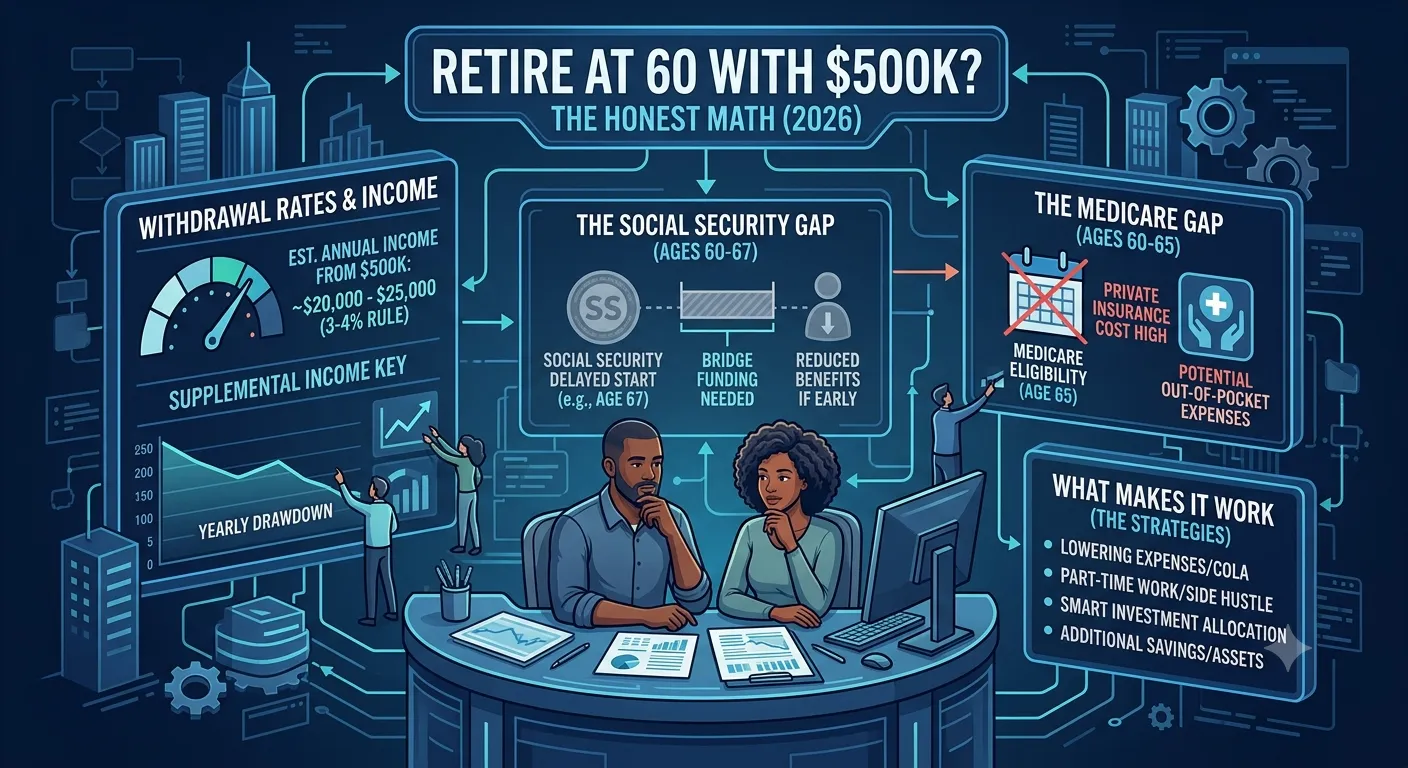
Retiring at 62 with $800,000 is a question of sequencing more than of the headline number. The portfolio has to carry you through three years before Medicare starts at 65, and through the decision of when to claim Social Security. This article walks through hypothetical math with 2026 figures so you can see where the plan may hold up and where it may strain.
The short answer
It may be possible, depending on your spending. A common 4% starting withdrawal on $800,000 is $32,000 a year before taxes. If you spend $50,000 a year, that is a 6.25% withdrawal rate until Social Security fills the gap. If you spend $35,000 to $40,000, the same portfolio looks much more comfortable. The reverse is also true: at $60,000 a year, the numbers get tight quickly.
The 4% figure is a rule of thumb from historical research, not a guarantee. We cover its limits in the 4% rule for retirement.
What changes at 62
Three things shift when you retire at 62 rather than 67 or later.
You are younger than Medicare eligibility. Medicare generally starts at 65, so you would likely need to cover health insurance for about three years on your own, through an employer retiree plan, COBRA, an ACA marketplace plan, or a spouse's coverage. Premiums vary widely by state, age, and income, so price real quotes for your situation instead of guessing. For reference, the 2026 standard Medicare Part B premium is $202.90 per month, which is what you would start paying at 65.
Your retirement may be longer. Retiring at 62 and living to 92 is a 30-year horizon. Every extra year of withdrawals raises the odds that a bad early market sequence does lasting damage.
Social Security is reduced if you claim at 62. If your full retirement age is 67, claiming at 62 means a benefit about 30 percent below your primary insurance amount (PIA). That reduction is permanent.
Worked example: $800k, $50k spending, two claiming strategies
Here is a deliberately simple hypothetical. All figures are in today's dollars, before taxes, and ignore inflation adjustments to keep the logic visible.
- Portfolio at 62: $800,000
- Spending: $50,000 per year
- PIA (benefit at full retirement age 67): $2,500 per month, or $30,000 per year
- Claiming at 62 would pay 70% of PIA: $21,000 per year
| Claim Social Security at 62 | Delay to 67 | |
|---|---|---|
| Annual benefit | $21,000 | $30,000 |
| Portfolio draw, ages 62 to 66 | $29,000 | $50,000 |
| Portfolio draw, age 67 onward | $29,000 | $20,000 |
| Initial draw rate (on $800k) | 3.6% | 6.25% |
Under delay, the portfolio pays the full $50,000 for five years, a $250,000 draw, and then needs only $20,000 a year. Under early claiming, the draw is steady at $29,000 but never gets smaller.
What happens at different returns
Using a simple model (each year the balance is reduced by the draw, then grown at a constant real return), the portfolio lasts until:
| Real return | Claim at 62 | Delay to 67 |
|---|---|---|
| 0% | Runs out around 89 | Runs out around 94 |
| 1% | Runs out around 94 | Lasts past 100 |
| 2% | Lasts past 100 | Lasts past 100 |
These are illustrations, not forecasts. Constant returns hide sequence risk, and a market drop in your first few years could change the picture a lot. But the pattern is useful: in this example, delaying only wins when the portfolio can actually survive the early, heavier draw years. If a bad market hits during the bridge, delaying forces you to sell more shares at low prices.
The bridge years: three ways to cover them
If you want to delay Social Security, you still need income from 62 to 67. Options may include:
- Portfolio withdrawals, as modeled above.
- Part-time work. In 2026, if you claim before full retirement age and keep working, benefits are reduced $1 for every $2 you earn above $24,480. That limit applies to people under full retirement age all year, so it mostly matters if you claim early and work.
- A cash or bond bucket that covers the first few years of spending so you are not forced to sell stocks in a downturn.
None of these is free. Each trades flexibility, risk, or time for something else.
Taxes can quietly change the number
The examples above are pre-tax. Withdrawals from traditional 401(k)s and IRAs are generally taxed as ordinary income. For 2026, the standard deduction is $16,100 for single filers and $32,200 for married couples filing jointly. For a single filer, the 10% bracket tops out at $12,400 of taxable income, the 12% bracket runs up to $50,400, and the 22% bracket begins above that. For joint filers, those thresholds are $24,800 and $100,800.
A mix of account types matters. Roth withdrawals and basis in a taxable brokerage account may lower your taxable income, which can also affect health insurance costs before 65. Later, higher income can trigger Medicare IRMAA surcharges, which for 2026 start above roughly $109,000 for single filers and $218,000 for joint filers. Your own numbers will differ, so a tax professional can help with specifics.
Stress tests worth running
Before deciding, consider asking these questions of your own plan:
- What if spending is 15% higher than expected? Health costs and home repairs are common surprises.
- What if the first three years of returns are negative? Early losses hurt more than later ones because you are drawing from a smaller base.
- What if one spouse claims early and the other delays? The higher earner delaying can raise the survivor benefit, which may matter for couples.
- What if you work part-time for two years? Even modest income can reduce early draws significantly.
A static calculator rarely handles all of this at once. A forecast that lets you change retirement age, claiming age, and spending, then see the result year by year, is more useful. See our guide to retirement planning and financial forecasting for how that works, and compare with the earlier math in can I retire at 60 with $500k and can I retire at 55 with $1 million.
A simple checklist for retiring at 62
- Estimate spending honestly, including health insurance until 65.
- Pull your Social Security estimate from your my Social Security account at ssa.gov.
- Model both claiming at 62 and delaying, using conservative return assumptions.
- Decide how you will fund the bridge years.
- Map account types for tax-efficient withdrawals.
- Rerun the plan yearly, or after any large change.
Run your own numbers
The right answer for $800,000 depends on your spending, your Social Security record, your health coverage, and your taxes. Create a free Mogul Bay account to project your net worth under different retirement ages and claiming strategies, and see when your plan may hold up or run short.
This article is for educational purposes only and is not financial, tax, or legal advice. Examples are hypothetical, use simplified assumptions, and do not predict future results. Consult a qualified professional before making retirement decisions.