Can I retire at 60 with $500k? The honest math (2026)
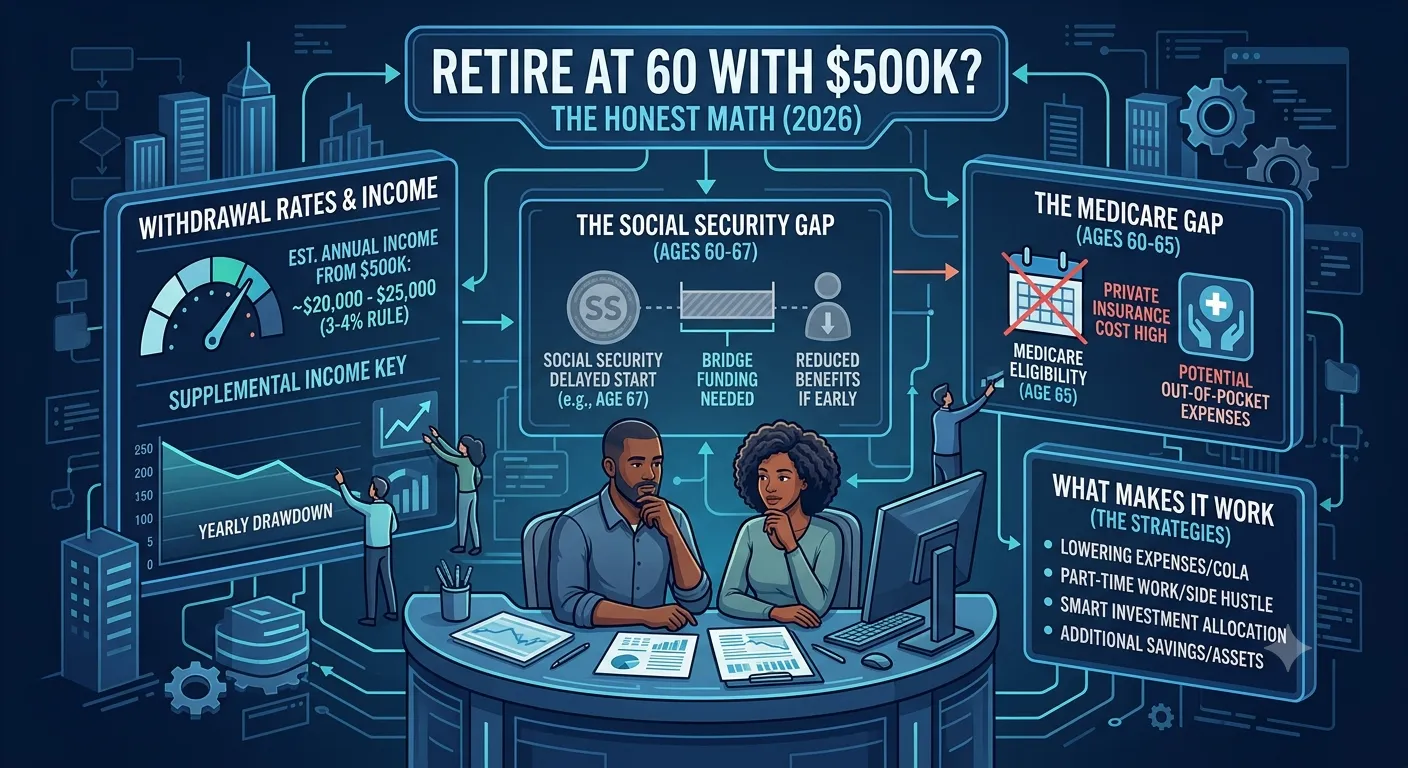
Retiring at 60 with half a million dollars is possible, but it's tight, and whether it works depends almost entirely on three things: how much you spend, how you bridge the years before Social Security and Medicare kick in, and how disciplined you are about your withdrawal rate. Let's run the actual numbers instead of guessing.
What $500k actually generates per year
The starting point is your safe withdrawal rate, the share of your portfolio you can pull each year with reasonable confidence you won't run out over a 30-plus-year retirement.
The famous 4% rule, created by William Bengen in the 1990s, would let you withdraw $20,000 in year one from a $500,000 portfolio, adjusted upward for inflation each year after. Bengen himself has since revised his thinking, suggesting 4.7% as a worst-case maximum and closer to 5% to 5.5% under normal conditions. Morningstar, on the other hand, is more conservative: its 2026 State of Retirement Income report puts the baseline safe rate at 3.9% for retirees using a fixed-spending strategy.
So depending on whose model you trust, $500k throws off somewhere between roughly $19,500 (Morningstar's 3.9%) and $27,500 (Bengen's optimistic 5.5%) in the first year. For honest planning, I'll use 4%, which gives you $20,000 a year. That's the number to anchor on, because retiring at 60 means your money has to last longer than a standard retirement, which argues for the more cautious end of the range, not the aggressive end.
The Social Security gap nobody plans for
Here's the part that catches early retirees off guard: you cannot claim Social Security at 60. The earliest you can file is 62, so retiring at 60 means at least two years living entirely off your portfolio with zero benefit income.
And claiming at 62 isn't free either. If your full retirement age is 67 (which it is for anyone born in 1960 or later), filing at 62 permanently reduces your monthly benefit by about 30%. That cut lasts the rest of your life.
For context, the average Social Security check for a retired worker was about $2,081 a month as of April 2026, or roughly $24,974 a year. But that's the average across all retirees, many of whom waited until full retirement age or later. If your full-retirement-age benefit would be around $2,000 a month, claiming at 62 drops it to roughly $1,400 a month, about $16,800 a year.
Putting it together: a realistic scenario
Say you're 60, single, with $500,000 and an average earnings record.
From 60 to 62, you live entirely on your portfolio. At a 4% withdrawal, that's $20,000 a year before taxes. For two years, you're drawing down without any benefit income, which is a meaningful strain on a $500k balance.
At 62, you file for Social Security at the reduced rate, roughly $16,800 a year in our example. Now your combined income looks like:
- Portfolio withdrawal: about $20,000
- Social Security (reduced): about $16,800
- Total gross income: about $36,800 a year
That's around $3,000 a month before taxes. For a single person who owns their home outright and lives modestly, that can work. For someone with a mortgage, dependents, or a higher cost-of-living area, it's going to be a stretch.
The healthcare problem from 60 to 65
Medicare doesn't start until 65. Retire at 60 and you have a five-year gap where you're responsible for your own health coverage, and this is one of the biggest hidden costs of retiring early.
Your main option is the Affordable Care Act marketplace. The good news is that ACA premium subsidies are based on your income, and an early retiree living on modest portfolio withdrawals often qualifies for substantial help. The catch is that your reported income, including taxable withdrawals and capital gains, directly affects how large that subsidy is. Pull too much from a taxable account or do a large Roth conversion, and you can accidentally price yourself out of subsidies. This is a real planning lever, and it's worth modeling carefully before you pull the trigger.
What would make $500k at 60 actually work
A few factors swing this from "risky" to "doable":
- Lower spending. If your all-in annual budget is closer to $35,000 than $55,000, the math holds up far better.
- A paid-off home. Eliminating rent or a mortgage is the single biggest lever for making a modest portfolio stretch.
- Delaying Social Security past 62. Every year you wait increases your benefit. If you can lean harder on the portfolio early and delay your claim, your lifetime guaranteed income rises.
- Part-time income. Even $10,000 to $15,000 a year from light work dramatically reduces the strain on your portfolio in the early years, which are the most dangerous for sequence-of-returns risk.
- A flexible withdrawal strategy. Retirees willing to trim spending in down markets can safely start higher; Morningstar found flexible spenders could justify rates closer to 5.7%.
The honest verdict
Can you retire at 60 with $500k? Yes, if you're a modest spender, ideally with no mortgage, you've planned for the healthcare gap, and you're comfortable with a combined income in the mid-$30,000s. No, if you're expecting a $60,000-a-year lifestyle or you haven't accounted for the two-year Social Security gap and five-year Medicare gap.
The difference between these outcomes isn't luck, it's planning. The same $500k can comfortably fund one person's retirement and fail another's, entirely based on spending, timing, and how the pieces fit together.
Run your own numbers
Averages and rules of thumb only get you so far. Your retirement depends on your actual savings, your real spending, your specific Social Security benefit, and the exact years you plan to bridge before benefits and Medicare start. Mogul Bay lets you model all of it: project your net worth forward, test different withdrawal rates, and see whether $500k (or whatever you have) actually lasts at the age you want to stop working.
Create a free Mogul Bay account and run your own numbers in a few minutes.
This article is for educational purposes only and is not financial, tax, or investment advice. Figures are illustrative estimates based on publicly available data as of 2026 and individual circumstances vary widely. Consult a qualified financial professional before making retirement decisions.