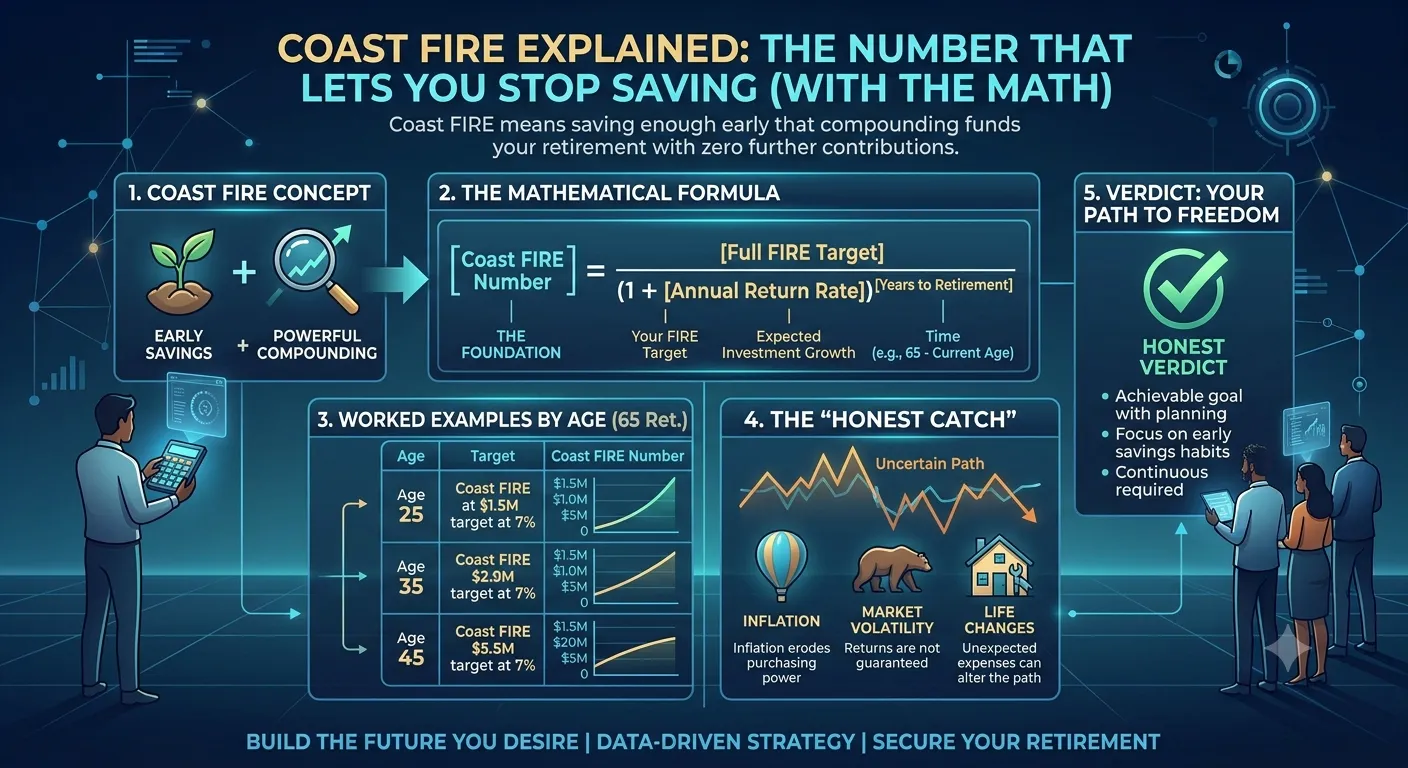
What Coast FIRE actually means
Coast FIRE describes a point where existing retirement investments may be able to grow to a future retirement target without additional retirement contributions, assuming the plan's return, inflation, time, and spending assumptions hold.
It is not the same as full financial independence. You still need enough current income to cover living costs and protect the invested balance from early withdrawals.
The distinction Traditional FIRE asks whether your assets can support spending today. Coast FIRE asks whether today's invested balance may grow enough to support spending at a later retirement age.
The basic Coast FIRE formula
The calculation starts with a future retirement target and discounts it back by an assumed real rate of return over the years remaining until retirement.
In simplified form: Coast number = future retirement target ÷ (1 + real return) ^ years. Real return means the assumed investment return after inflation.
- Estimate annual retirement spending
- Choose a withdrawal-rate assumption
- Calculate the future target
- Discount that target by the assumed real return and years remaining
Use a range Small changes in return, retirement age, or spending can materially change the Coast number. Test conservative and optimistic cases instead of relying on one result.
The honest catch
Markets do not grow in a straight line, and life rarely follows a fixed spreadsheet. Career breaks, health costs, family support, housing changes, taxes, and fees can all alter the result.
The model also assumes the retirement balance remains invested. Using those funds early can reduce the time compounding has to work and may move the Coast point further away.
- Investment returns may be lower than assumed
- Inflation may affect different spending categories unevenly
- Retirement spending can change over several phases
- Taxes and account type affect what is available to spend
How to use the number responsibly
Treat Coast FIRE as a planning milestone rather than permission to stop paying attention. Recalculate periodically and after major changes to income, spending, assets, or retirement timing.
Reaching the milestone can create options: reduce hours, change careers, direct savings to another goal, or simply maintain contributions and build a larger margin of safety.